
The Convergence Point in Knowledge-Time
February 16, 2026
Transcript:
The Convergence Point in Knowledge-Time
The Velocity of Reaching a Noetic Moment
In 1998, Porsche ran a two-page advertisement featuring a faintly lit 911 emerging from shadow. The image was restrained, almost understated. The headline did the real work:
“Everything we know so far.”
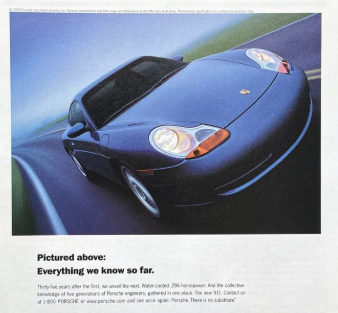
It was an extraordinary sentence.
In eleven words, Porsche acknowledged three things:
-
They had been doing this for a long time.
-
They were proud of the progress embodied in that car.
-
They were not finished.
It was confidence without finality.
Mastery without arrogance.
The car was not presented as perfection. It was presented as the best articulation of engineering knowledge available at that moment.
That moment had a coordinate.
We can call that coordinate Knowledge-Time.
Knowledge-Time is the state of understanding available at a specific moment—shaped by current tools, evidence, constraints, and intellectual maturity. Every serious statement exists at a particular point in Knowledge-Time. It reflects what is known—so far.
For most of history, Knowledge changed slowly. A student could study physics, psychology, or law in college, begin a career, and still refer to the same foundational texts decades later. Refinement occurred. Nuance deepened. But the baseline moved gradually. The gap between January and February rarely redefined the intellectual landscape.
Knowledge advanced—but at a human tempo.
William James and the Noetic Moment
In The Varieties of Religious Experience, William James described certain experiences as possessing a noetic quality—moments that carry the feeling of direct apprehension of truth.
Not persuasion.
Not argument.
Not incremental deduction.
Recognition.
A Noetic Moment is the point at which intuition and articulation converge and something inside the thinker says:
“That’s it.”
It is not eternal truth.
It is not immune to revision.
It is not guaranteed to survive the next shift in Knowledge-Time.
It is a lived experience of coherence.
The Noetic Moment is something a human experiences when it happens.
James was writing about religious experience. But the concept extends beyond theology. The Noetic Moment appears whenever vague intuition crystallizes into articulated clarity—when half-formed structure becomes graspable.
For centuries, the path toward that moment was slow.
The Historical Velocity of Thought
Speed has always mattered in intellectual life.
Albert Einstein is remembered not simply for intelligence, but for the velocity at which he could move from ambiguity to theoretical coherence. Isaac Newton compressed mathematical reasoning into structural breakthroughs that defined physics for generations. Marie Curie navigated experimental uncertainty toward refined understanding under conditions of immense constraint.
Robin Williams is recognized for intellectual brilliance not because he memorized jokes, but because of the apparent speed at which his mind operated. In improvisational comedy, he could leap from premise to punchline in real time, collapsing associative pathways that others required minutes—or hours—to traverse.
Brilliance has often meant reduced latency between problem and insight.
But until recently, that velocity was bounded by biology, memory, and available tools.
What Is Possible Now
The shift in 2026 is not mystical. It is infrastructural.
It is now possible for a single human to externalize vague intuition rapidly, iterate through articulation without social friction, preserve thread continuity, and test framing in real time—with the assistance of computers capable of sustaining context and generating structured responses instantly.
Computers do not create the Noetic Moment.
They increase the velocity of reaching it.
They accelerate articulation.
They surface structure.
They reduce conversational latency.
They tolerate silence.
They preserve continuity.
The experience of convergence—the moment of recognition—remains human.
What has changed is tempo.
In many domains today, what was articulated in January may no longer hold in February. The interval between Knowledge-Time coordinates has compressed. Tools evolve monthly. Models update weekly. Interfaces shift daily. The pace of iteration has accelerated.
We are not compressing thought.
We are not reducing a “distance” to truth.
We are increasing the velocity of reaching a Noetic Moment.
The Velocity of Thought
Velocity here means cadence—the rhythm at which intuition is tested, articulated, refined, and recognized.
A thinker can now arrive at more convergence points in a single afternoon than might once have occurred in a month of private rumination.
More articulated positions.
More visible refinement.
More coordinates declared in Knowledge-Time.
This does not guarantee correctness.
It does not guarantee wisdom.
It does not eliminate the need for discipline.
It changes tempo.
Acceleration and Arrogance
Velocity introduces risk.
Acceleration without epistemic humility produces arrogance.
When articulation becomes easy, fluency can masquerade as understanding. Speed can be mistaken for certainty. The ability to generate structure rapidly can create the illusion of mastery.
Tempo can intoxicate.
The Porsche line guards against this:
“Everything we know so far.”
Velocity must be paired with Knowledge-Time awareness. Every Noetic Moment must be held lightly, aware that it exists within a coordinate that will inevitably shift.
Acceleration without humility becomes delusion.
Acceleration with humility becomes disciplined iteration.
The Convergence Point
The real shift is not artificial intelligence replacing thought.
It is the democratization of intellectual tempo.
The Noetic Moment—the felt convergence of intuition and articulation—remains a human experience.
What has changed is how quickly a disciplined thinker can arrive there.
The Porsche engineers knew what they had built. They were proud of it. But they understood that it represented a point, not a pinnacle.
Everything we know.... So far.